China-EU Summit Tensions Over Trade and Ukraine

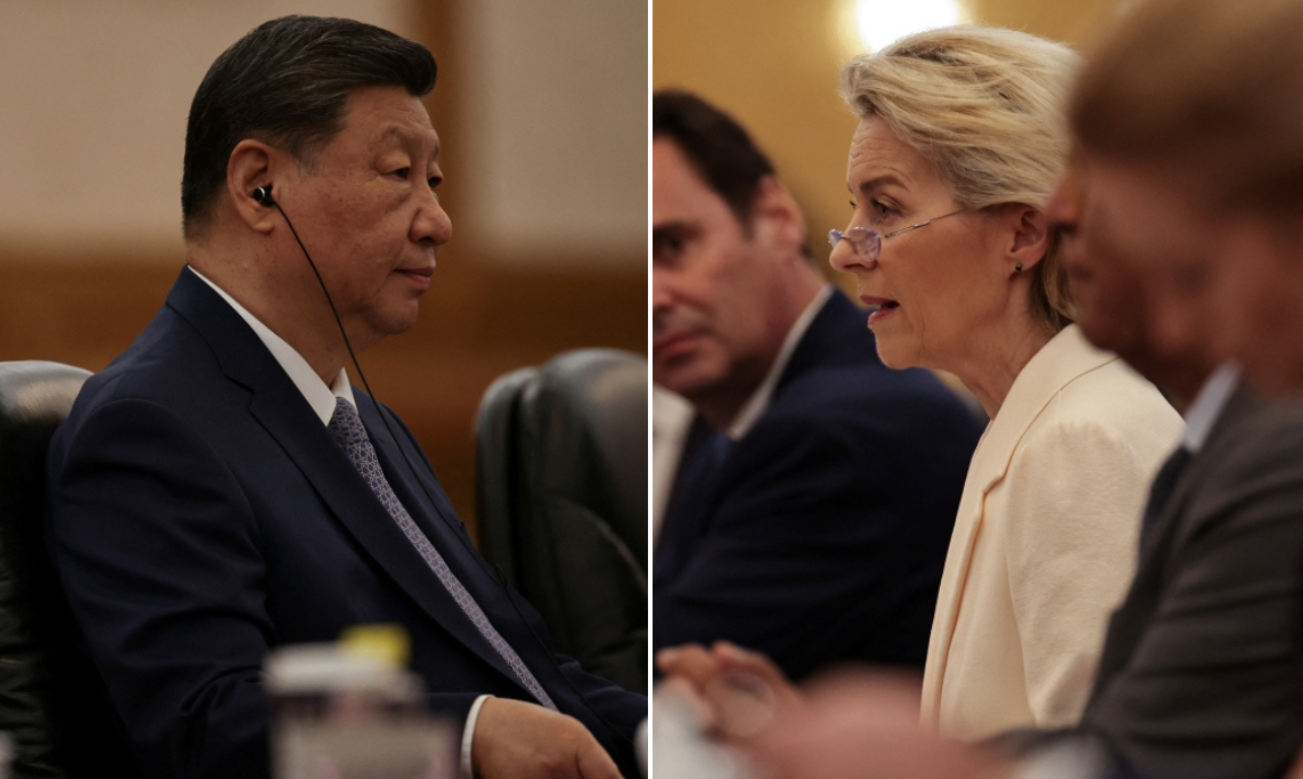
Beijing — Chinese President Xi Jinping called for stronger ties and mutual trust with the European Union during a high-stakes summit in Beijing on Thursday, despite growing tensions over trade imbalances, Beijing’s support for Moscow, and limited market access for European firms.
The meeting, nominally meant to celebrate 50 years of diplomatic relations, took place under the shadow of deepening friction. Xi told European Commission President Ursula von der Leyen and European Council President Antonio Costa that in a world facing “turmoil,” China and the EU must “make correct strategic choices that meet the expectations of the people and stand the test of history.”
Xi emphasized that both sides could find “common ground,” even though tensions span a wide range of issues — from a soaring trade deficit and industrial subsidies to human rights and Russia’s war in Ukraine.
Beijing, presenting itself as a more reliable global partner than Washington, has actively sought to draw Europe closer. However, Brussels has grown increasingly vocal about unfair competition from heavily subsidized Chinese goods, limited access to the Chinese market, and China’s perceived tacit backing of Russia’s aggression in Ukraine.
Earlier in the day, von der Leyen wrote on X (formerly Twitter) that the visit was an “opportunity to both advance and rebalance our relationship,” adding she remained convinced that “mutually beneficial cooperation” was still possible.
President Costa stressed that progress on trade was essential. “We need concrete progress on issues related to trade and the economy, and we both want our relationship to be mutually beneficial,” he said.
Trade, Tariffs, and Rare Earths
The EU’s top concern remains the massive trade deficit with China — valued at around $360 billion last year — which von der Leyen has called “unsustainable.” Brussels is also pushing for better access to the Chinese market for European companies and fewer restrictions on the export of rare earth elements vital to high-tech industries.
In response, Beijing has dismissed these concerns and urged the EU to “rebalance its mentality,” not just its trade policies.
Meanwhile, a trade dispute over Chinese electric vehicles has further strained relations. The EU recently imposed tariffs on Chinese EV imports, accusing China of distorting the market through state subsidies. In apparent retaliation, Beijing launched investigations into imports of European pork, dairy, and brandy.
Ukraine War and Security Concerns
Another critical sticking point is China’s deepening ties with Russia. Since Moscow’s full-scale invasion of Ukraine in 2022, China has maintained strong political and economic relations with Russia — a position that the EU views as indirect support for the war.
Brussels recently imposed a fresh round of sanctions on Moscow, targeting two Chinese banks accused of facilitating sanctions evasion. In response, China’s commerce minister issued strong objections to his EU counterpart.
“This is a core issue for Europe,” said a senior EU official, pointing out that Chinese firms supply nearly 80% of dual-use goods — items with both civilian and military applications — to Russia.
“We’re not naive,” the official added. “We’re not asking China to cut ties with Russia, but we do expect greater controls over customs and financial flows.”
A Difficult But Necessary Dialogue
Despite acknowledging the tensions, EU officials maintained that face-to-face discussions were essential. “We know that we don’t see eye to eye with China on many issues,” said the senior official. “But it is crucial to have direct, open, and constructive dialogue at the highest level.”
As both sides continue to navigate a complicated relationship, the summit underscored the need for strategic balance, economic cooperation, and clear boundaries — particularly in an era of growing geopolitical fragmentation.
Mutib Khalid is a skilled content writer and digital marketer with a knack for crafting compelling narratives and optimizing digital strategies. Excel in creating engaging content that drives results and enhances online presence. Passionate about blending creativity with data-driven approaches, Mutib Khalid helps brands connect with their audience and achieve their goals.