Trump Tariffs Fuel Market Chaos Recession Fears

Meanwhile, the turmoil unleashed by Trump’s tariffs showed few signs of easing on Friday, with markets tumbling and foreign leaders puzzling how to respond to the biggest disruption to the world trade order in decades.
A brief reprieve for battered stocks seen after Trump decided to pause duties for dozens of countries for 90 days quickly dissipated, as attention returned to his escalating trade war with China that has fuelled global recession fears.
Global stocks fell, the dollar slid, and a sell-off in U.S. government bonds picked up pace on Friday, reigniting fears of fragility in the world’s biggest bond market. Gold, a haven for investors in times of crisis, scaled a record high.
“Recession risk is much, much higher now than it was a couple weeks ago,” said Adam Hetts, global head of multi-asset at Janus Henderson.
U.S. Treasury Secretary Scott Bessent tried to assuage sceptics by telling a cabinet meeting on Thursday that more than 75 countries wanted to start trade negotiations. Trump himself expressed hope of a deal with China, the world’s No.2 economy.
But the uncertainty in the meantime extended some of the most volatile trading since the early days of the COVID-19 pandemic.
Asian indices mostly followed Wall Street lower on Friday. In Europe, China’s latest tariff hike sent stocks lower, leaving the STOXX 600 (.STOXX), opens new tab down more than 1% on the day and set for another drop this week, one of its most volatile on record.
Bessent shrugged off the renewed market turmoil on Thursday and said striking deals with other countries would bring certainty.
The U.S. and Vietnam have agreed to begin formal trade talks, the White House said. The Southeast Asian manufacturing hub is prepared to crack down on Chinese goods being shipped to the United States via its territory in the hope of avoiding tariffs, Reuters exclusively reported.
Japanese Prime Minister Shigeru Ishiba, meanwhile, has set up a trade task force that hopes to visit Washington next week.
CHINA DEAL?
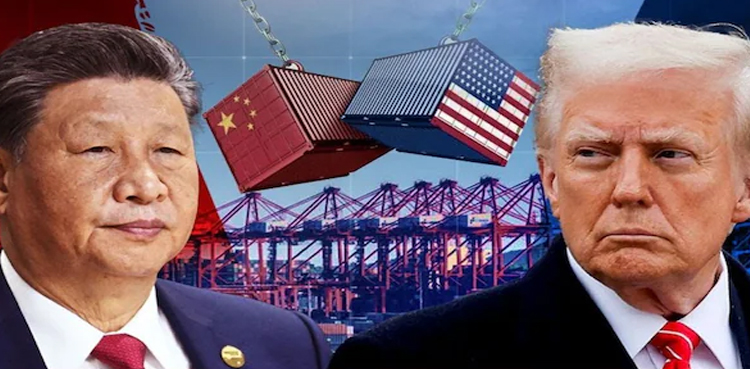
As Trump suddenly paused his ‘reciprocal’ tariffs on other countries hours after they came into effect earlier this week, he ratcheted up duties on Chinese imports as punishment for Beijing’s initial move to retaliate.
He has now imposed new tariffs on Chinese goods of 145% since taking office, a White House official said.
China hit back with new tariffs on Friday.
“The U.S. imposition of abnormally high tariffs on China seriously violates international and economic trade rules, basic economic laws and common sense and is completely unilateral bullying and coercion,” China’s finance ministry said in a statement.
This map shows the percentage of reciprocal tariffs imposed by the U.S. administration on each economy.
Trump told reporters at the White House on Thursday that he thought the United States could make a deal with China and said he respected Chinese President Xi Jinping.
“In a true sense, he’s been a friend of mine for a long period, and I think that we’ll end up working out something very good for both countries,” he said.
Xi, in his first public remarks on Trump’s tariffs, told Spanish Prime Minister Pedro Sanchez during a meeting in Beijing on Friday that China and the European Union should “jointly oppose unilateral acts of bullying,” China’s state news agency Xinhua reported.
“There are no winners in a trade war,” the Chinese leader told his guest, adding that by acting together, the world’s second-largest economy and the 27-strong European trade bloc could help uphold “the global rules-based order.”
European authorities estimate the impact of the U.S. tariffs on the region’s economy would total 0.5% to 1.0% of the GDP. Given that the EU economy as a whole is forecast to grow by 0.9% this year, according to the European Central Bank, the U.S. tariffs could tip the EU into recession.
The euro has surged 1.7% to $1.13855, a level last seen in February 2022.
Trump’s decision for a 90-day suspension on tariffs gave room for only a “fragile pause,” French President Emmanuel Macron said, partly because tariffs on steel, aluminium, and cars remained, as well as across-the-board 10% duties.
Fragile, also, “because this 90-day pause means 90 days of uncertainty for all our businesses, on both sides of the Atlantic and beyond,” Macron said on X.
Mutib Khalid is a skilled content writer and digital marketer with a knack for crafting compelling narratives and optimizing digital strategies. Excel in creating engaging content that drives results and enhances online presence. Passionate about blending creativity with data-driven approaches, Mutib Khalid helps brands connect with their audience and achieve their goals.